RETENTION & UPSELL FOR SUBSCRIPTION SOFTWARE
Turn your existing users into a revenue engine
Introducing Flow, Obviable's custom predictive product.
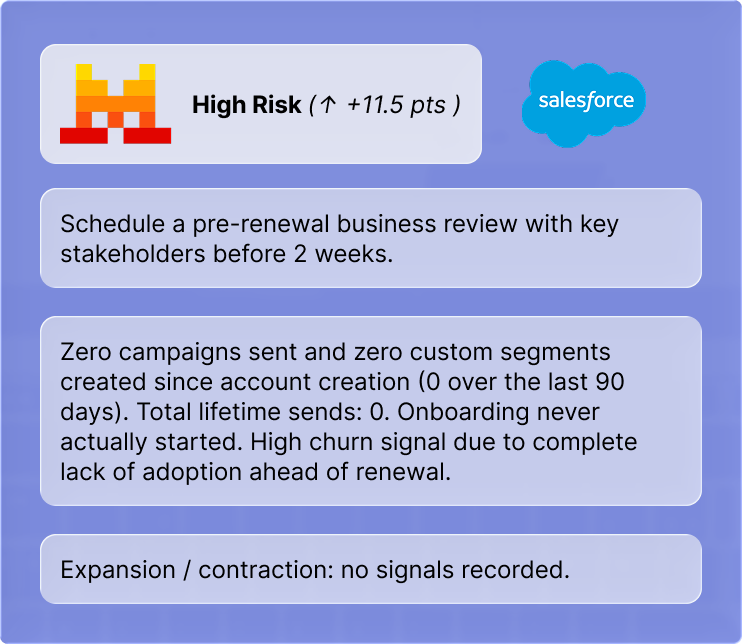
Know who's at risk, who's ready to grow, and what to do next.
Directly in the tools your teams already use.
Built on your historical product usage.
- 20%
- More Account Growth
- 2x
- Team Capacity
- 95%+
- Revenue Forecast Accuracy
- 100%
- Done-for-you
STRATEGIC CLIENT LAYER
Detect risk and opportunity across every account
Most B2B SaaS teams don't lack data, they lack timely revenue signals, buried in manual workflows and fragmented systems that create friction instead of clarity. Obviable handles everything behind the scenes and pushes actionable churn and upsell signals directly into your CRM, with measurable ROI at every stage.
Today, 40% of customers signaling churn end up staying. Surprisingly, 20% of those 'leavers' actually upgrade to a higher plan once we address their needs. Imagine the MRR we could capture if we identified these signals 3 months earlier, before they even looked at the competition.

Built around your product, our edge is depth
Most tools run the same generic playbook on every company. We go the other way, and build the engine around how your customers actually use your product. We go deep on your usage data to find the custom signals that actually predict churn and growth for your product.
Predict early, explain why
A statistically sound score flags which accounts are at risk or ready to grow, weeks ahead. An AI layer spells out the reason in plain words, so your team knows what to do.
We go deep on usage data
This is our edge. Most platforms just wire a few sources into a connector. We study how people really use your product and engineer custom behavioral metrics, far richer than generic ones, tuned to how churn and growth work for your product.
Proof before you commit
Before any deployment, we measure the return on your own past data. You see what it's worth before paying for the run. And once live, we track the revenue impact of every alert, so you always know exactly what Obviable is worth to your MRR.
Not another tool to learn
Everything lands in the tools your team already uses. Nothing new to log into.
Done for you, end to end
We take your raw data and handle the plumbing: cleaning, preparation, and what to start tracking. No integration project on your side, and no hidden costs.
WHAT CHANGES FOR YOUR ROLE
Revenue Growth runs on rhythm
See how client-facing teams, RevOps, Leaders and Growth use Obviable to hit their numbers, every day.
Industrialize detection
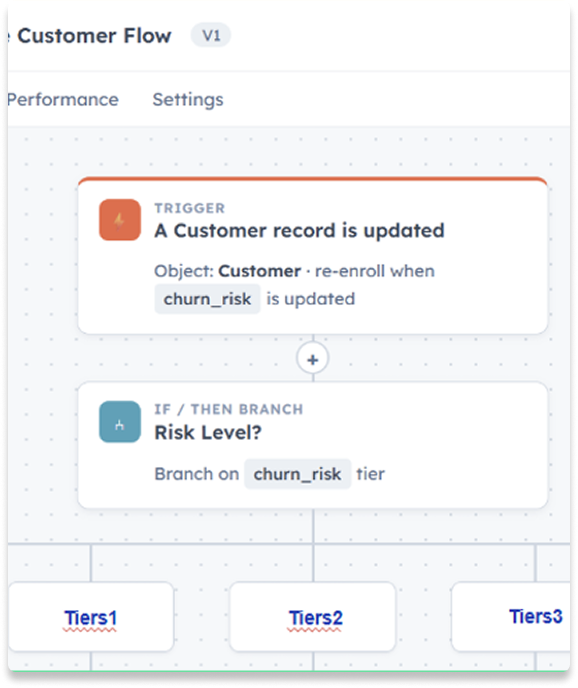
Risk and growth signals based on behavior, calibrated on your own won and lost accounts, refreshed automatically.
Insights people actually use
Health scores and alerts land in your existing tools, from the field to the board.
Measure what works
See what your team did, what it earned, and what's left to do, in one place.
Security
One isolated home for your data
Each client runs in its own environment. Your data is never pooled, shared, or used for anything but your own predictions.
One isolated instance per client
Your data lives in its own dedicated environment. It is never pooled, mixed, or compared with another client's data.
Only the data we need
We ask for the data required to make predictions, nothing more, and can work with pseudonymized identifiers when personal details are not necessary.
Encrypted and access-limited
Data is encrypted in transit and at rest, and access is limited to the few people running your engine.
European, GDPR-aligned
We are based in Europe and work the General Data Protection Regulation (GDPR) way, including signing a Data Processing Agreement before any data moves.
Never used to train anything but your engine
Because each instance is isolated, your data only ever serves your predictions. It never feeds a shared or generic model.
You stay in control
You grant access through your own connectors, and you can cut it off at any time. You decide what we connect to, and we document exactly what we use.
FAQ
Questions people ask first
# Product
1.In plain words, what does Obviable actually do?
Obviable learns how each of your customers really uses your product, then predicts which accounts are at risk of leaving and which are ready to buy more, weeks before it shows up in your revenue. For every alert you get a plain-language reason and a recommended next step, delivered right inside the tools your team already uses. Think of it as an early-warning and growth-radar system for your customer base.
2.What do we actually get in our daily workflow?
Every run you get four things: • a health score for every account (low / medium / high) • an artificial-intelligence (AI) memo on each alert explaining what is happening and what to do • a metrics table covering all accounts • a weekly digest None of it lives in a new dashboard you have to learn; the scores, reasons and next steps land directly in Slack, Salesforce, HubSpot or wherever your team already works. So it adds clarity to your existing workflow rather than another tool to log into.
See what you get →3.How is this different from our current CRM, CS Platform, or LLM (ChatGPT...)?
Generic Customer Success and CRM platforms run the same template on every company and still need you to configure and maintain them; our edge is going deep on your specific usage data to build signals tuned to how churn and growth actually work for your product. Building it in-house means hiring data scientists and pulling focus from your roadmap, and a tool like ChatGPT can summarize text but cannot reliably predict churn on your historical data. We do the whole thing for you, end to end, and prove the value before you pay for the run.
How it works →4.Do you just hand us a risk score?
You always get the why and the what, never just a score. A statistical model flags the risk early, and an AI layer writes a short memo in plain language: the main driver, the context, and a recommended action your team can take before the call. That is the difference between an alert that creates work and one that saves it.
5.How long until we go live?
It depends on what you need. If you want to measure your predictability score, you get results in 2 weeks with Signal. If you want the full Flow engine running continuously, deployment takes 12 weeks. We work in sprints with concrete, usable outputs at every phase, rather than a long wait for a single reveal. The engine simultaneously maps churn risks and upsell opportunities.
Go to Pricing →# Business Value
6.Who is this for?
Obviable is engineered for B2B SaaS companies at three critical inflection points: • Securing revenue predictability: critical if NRR is a board priority, under profitability pressure, or preparing a fundraising/exit. → Secure your recurring revenue forecast. • Scale-up or transformation: critical if growing fast, navigating mergers, or teams have conflicting views on account health. → Align every team via objective user-behavior data. • Modernizing customer segmentation: critical if struggling to identify the right behavioral triggers or configure health scores/CRMs. → Isolate real drivers built on actual product usage. It fits best when you have enough usage history to learn from and more accounts than your team can watch closely by hand. If you bill by usage (pay-as-you-go) rather than fixed seats, it still works, the signals just come from how much customers actually use the product. Obviable is useful for Heads of Customer Success, Revenue Operations / Chief Revenue Officers, and CEOs.
Go to Solutions →7.How do we know it will pay for itself?
Before any deployment, we run the engine on your own past data and measure the return: how many at-risk accounts it would have caught early and what that is worth to you. You see that proof first, then decide whether to pay for the ongoing run. We would rather show the value on your numbers than ask you to take headline metrics on faith.
See how it works →8.What is the pricing model?
It depends on what you need: only a one-shot or a custom predictive engine. You are billed by your number of customers, not per seat, so the cost scales with your business in a predictable way.
See Pricing →# Tech & Security
9.How much engineering work is required from our team?
Zero. It is entirely done-for-you. We ingest your raw usage, billing, and CRM data, then handle the cleaning and integration ourselves. Our involvement is light, mainly granting access and a few alignment touchpoints, and you do not need pristine data to start because checking and improving data quality is part of what we do. The whole point is that this does not become another stalled internal project.
See how it works →10.Is my customer data safe, and is it kept separate from your other clients?
Yes. Each client gets one fully isolated instance, so your data is never pooled or mixed with anyone else's, and we are based in Europe with General Data Protection Regulation (GDPR) practices in mind, including signing a Data Processing Agreement. We only need the data required to make predictions and can work with pseudonymized identifiers where personal details are not necessary.
Go to Security →# Track Record
11.Who is behind Obviable?
Obviable is built by a France-based team that combines machine-learning engineering with hands-on customer retention experience, co-founded by Sonia Bouanane and Simon Grah. The approach reflects years of turning messy behavioral data into reliable, automated retention workflows.
See About →